
A real estate agent coordinates the closing process by managing communication, deadlines, inspections, and paperwork across every party involved in the transaction. This coordination role is

Dated: July 4 2026
Views: 295

A real estate agent coordinates the closing process by managing communication, deadlines, inspections, and paperwork across every party involved in the transaction. This coordination role is distinct from the closing agent, who is a neutral third party responsible for legal documents and funds. Understanding the difference between these two roles is the first step to knowing what to expect when your deal moves toward the finish line. Whether you are buying or selling, your agent is the project manager keeping everything on track, and Herndonhomeguide connects you with experienced professionals who do exactly that in Northern Virginia's fast-moving market.
The real estate agent acts as the central point of contact for buyers, sellers, lenders, and title companies throughout the closing period. Think of the agent as the quarterback of the transaction, managing communication flows and serving as an early-warning system to prevent delays. When a lender needs a document, the agent follows up. When a title concern surfaces, the agent flags it immediately. This proactive communication is what separates a smooth closing from a stressful one.
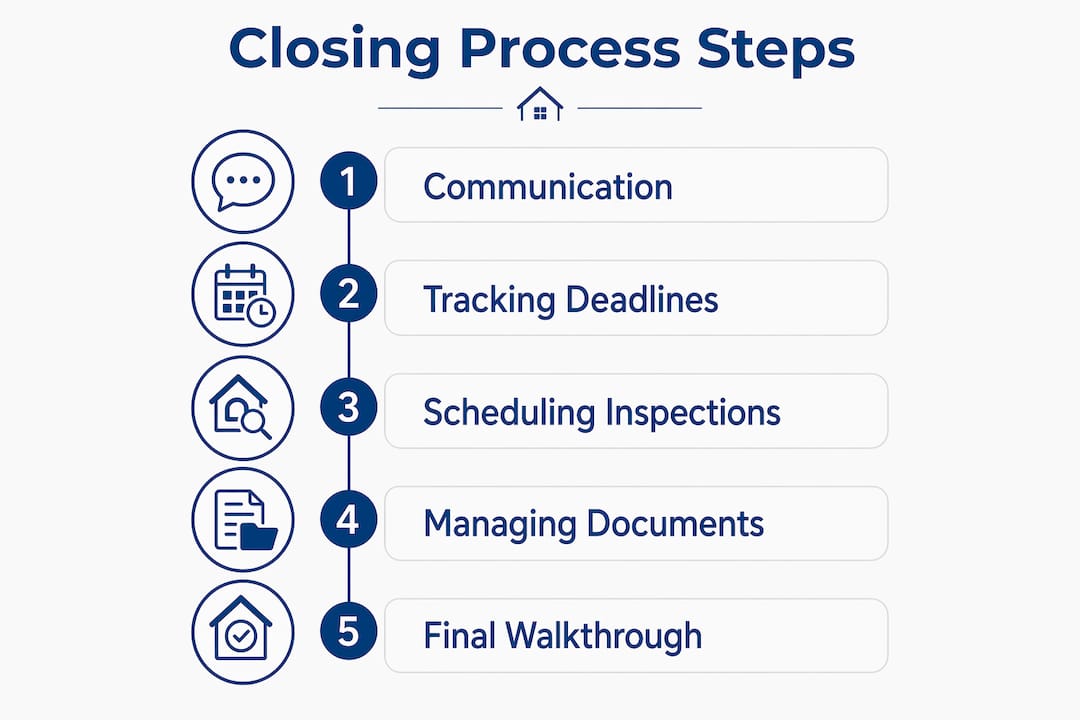
Agent responsibilities at closing cover a wide range of tasks, and the timeline matters as much as the tasks themselves. Here is the sequence most experienced agents follow:
Pro Tip: Ask your agent to share a written timeline at the start of the closing period. A clear deadline map reduces confusion and gives you a reference point if anything shifts.

The closing meeting itself involves multiple parties signing a stack of documents, and the agent's role there is supportive rather than legal. Agents are not legal authorities at closing but provide critical support by simplifying jargon, troubleshooting issues, and managing last-minute negotiations. That distinction matters. Your agent is your advocate and interpreter, not the person certifying the legal transfer of property.
The Closing Disclosure is a five-page federal document that itemizes every cost in the transaction. Your agent walks you through it before closing day so nothing surprises you at the table. Buyers receive this document at least three business days before closing under the TRID rule, a federal Consumer Financial Protection Bureau requirement. Your agent flags any line items that differ from the Loan Estimate so you can question them before signing.
Last-minute problems are common, and experienced agents expect them. A repair that was not completed, a wire transfer that did not clear, or a title question that surfaced the day before closing can all threaten the timeline. Your agent contacts the relevant party directly, whether that is the seller's agent, the lender, or the title company, and works toward a resolution before the closing appointment. That rapid response is one of the clearest signs of a skilled agent.
The closing agent and the real estate agent have separate, non-overlapping jobs. The closing agent is a neutral third party who ensures legal compliance, collects and disburses funds, prepares settlement statements, and records deeds. The real estate agent, by contrast, is your advocate and communicator. Confusing the two roles leads to misplaced expectations on closing day.
Here is how the two roles divide the work:
On the question of who chooses the title company: consumers ultimately decide which title company to use. Agents, attorneys, and lenders can recommend providers, but the final choice belongs to the buyer. Your agent's job is to give you enough information to make that choice confidently, not to make it for you.
| Role | Primary responsibility |
|---|---|
| Real estate agent | Client advocate, communication coordinator, deadline manager |
| Closing agent | Neutral party handling funds, legal documents, and deed recording |
| Title company | Title search, title insurance, and often provides the closing agent |
| Lender | Issues loan documents and confirms final loan approval |
Closing rarely goes exactly as planned. The most experienced agents treat obstacles as expected variables, not emergencies. Knowing the most common problems helps you understand why your agent is working behind the scenes even when things look quiet from your side.
Experienced agents set reminders for all critical deadlines, including inspections and financing contingencies, to prevent delays. That calendar discipline is what keeps small problems from becoming deal-killers.
Pro Tip: If your lender requests additional documents, respond within 24 hours. Delays on your end can push the closing date and trigger contract penalties.
Preparation is where agents earn their fee in the final stretch. The steps in the closing process on the day itself go smoothly when clients know exactly what to bring, what to sign, and what happens next.
For sellers, the agent also confirms that all personal property listed in the contract has been removed and that utility transfers are scheduled for the closing date. These details are easy to overlook and expensive to fix after the fact.
The real estate agent coordinates the closing process by managing communication, tracking deadlines, and advocating for the client, while the closing agent handles legal documents and funds as a neutral third party.
| Point | Details |
|---|---|
| Agent as coordinator | Your agent manages all parties, deadlines, and documents to keep the transaction on schedule. |
| Final walkthrough timing | Agents schedule the walkthrough 24–48 hours before closing to verify repairs and home condition. |
| Closing agent is neutral | The closing agent handles funds, settlement statements, and deed recording, not your agent. |
| 48-hour prep email | Agents send a detailed checklist before closing day to eliminate last-minute document surprises. |
| Title company choice | Buyers choose the title company. Agents recommend options but the decision belongs to you. |
After working through dozens of closings in Northern Virginia, the pattern I see most often is this: the transactions that go sideways are almost never caused by a single big problem. They unravel because of small communication gaps that compound over time. A lender did not get a document. A repair was assumed to be done but never confirmed. A buyer did not know to bring a cashier's check instead of a personal check.
The agent's job is to close those gaps before they become problems. I track every deadline on a shared calendar and send reminders 48 hours before each one. I call the lender directly instead of waiting for an email. I walk my clients through the Closing Disclosure before we ever sit down at the table, so nothing on that document is a surprise.
What I tell every client is this: closing day should feel boring. If it feels exciting or stressful, something was not handled early enough. A well-coordinated closing is quiet because the work happened in the weeks before. Choosing a local real estate expert who knows the Northern Virginia market means you get someone who has seen every variation of these problems and knows how to resolve them fast.
The one thing I would add that most articles skip: ask your agent how they track deadlines. The answer tells you everything about how they will manage your closing.
— Mazin
Closing a home in Herndon, Reston, or Great Falls involves coordinating lenders, title companies, inspectors, and attorneys, all on a tight timeline. Herndonhomeguide connects you with Mazin Abdelhameid, a local expert who manages every step of that process on your behalf.
https://herndonhomeguide.com" loading="lazy" decoding="async" src="https://csuxjmfbwmkxiegfpljm.supabase.co/storage/v1/object/public/blog-images/organization-35040/1780416098638_herndonhomeguide.jpg" style="box-sizing: border-box; border: 0px solid lab(91.6229 -0.159115 -2.26791); margin: 2em 0px; padding: 0px; vertical-align: middle; display: block; max-width: 100%; height: auto; margin-inline: auto; max-height: 400px; object-fit: contain;" />
From the first deadline to the final signature, Mazin tracks contingencies, prepares you for closing day, and resolves issues before they affect your timeline. Buyers and sellers in Northern Virginia work with an agent who knows the local market and the people in it. Visit Herndonhomeguide to connect directly and get the personalized closing support your transaction deserves.
An agent manages communication among all parties, tracks deadlines, schedules inspections and walkthroughs, and prepares clients for closing day. The agent is your advocate and problem-solver throughout the transaction.
The real estate agent coordinates the transaction and represents the client's interests. The closing agent is a neutral third party who handles funds, prepares settlement statements, and records the deed.
The final walkthrough typically occurs 24–48 hours before the closing appointment. The agent accompanies the buyer to confirm repairs are complete and the home is in the agreed condition.
The buyer chooses the title company. Agents, lenders, and attorneys can recommend providers, but the final decision belongs to the buyer.
Bring a government-issued photo ID, your certified or cashier's check for the exact amount listed on the Closing Disclosure, and any lender-required documents. Your agent will send you a detailed checklist 48 hours before the appointment.
A real estate agent coordinates the closing process by managing communication, deadlines, inspections, and paperwork across every party involved in the transaction. This coordination role is
What Does Real Estate Seasonality Mean for Buyers?Real estate seasonality is defined as the predictable annual cycle of fluctuations in buyer demand, home inventory, and prices that repeat at
Reston Homeowners Association: 2026 Resident GuideThe Reston Homeowners Association is the primary community organization governing property standards, amenities, and neighborhood rules for most
Work With a Buyer Agent Effectively in 2026A buyer's agent is defined as a licensed real estate professional who represents the buyer's legal and financial interests throughout the entire purchase
 Copyright© 2026 REIN Inc. Information Deemed Reliable But Not Guaranteed. The listings data displayed on this medium comes in part from the Real Estate Information Network Inc.(REIN) and has been authorized by participating listing Broker Members of REIN for display. REIN's listings are based upon Data submitted by its Broker Members, and REIN therefore makes no representation or warranty regarding the accuracy of the Data. All users of REIN's listings database should confirm the accuracy of
the listing information directly with the listing agent. Copyright ©2026 REIN. REIN's listings Data and information is protected under federal copyright laws.Federal law prohibits, among other acts, the unauthorized copying or alteration of, or preparation of derivative works from, all or any part of copyrighted materials, including certain compilations of Data and information. COPYRIGHT VIOLATORS MAY BE SUBJECT TO SEVERE FINES AND PENALTIES
UNDER FEDERAL LAW.
REIN updates its listings on a daily basis. Data last updated: September 21, 2026 1:27 PM UTC
Show More...
Copyright© 2026 REIN Inc. Information Deemed Reliable But Not Guaranteed. The listings data displayed on this medium comes in part from the Real Estate Information Network Inc.(REIN) and has been authorized by participating listing Broker Members of REIN for display. REIN's listings are based upon Data submitted by its Broker Members, and REIN therefore makes no representation or warranty regarding the accuracy of the Data. All users of REIN's listings database should confirm the accuracy of
the listing information directly with the listing agent. Copyright ©2026 REIN. REIN's listings Data and information is protected under federal copyright laws.Federal law prohibits, among other acts, the unauthorized copying or alteration of, or preparation of derivative works from, all or any part of copyrighted materials, including certain compilations of Data and information. COPYRIGHT VIOLATORS MAY BE SUBJECT TO SEVERE FINES AND PENALTIES
UNDER FEDERAL LAW.
REIN updates its listings on a daily basis. Data last updated: September 21, 2026 1:27 PM UTC
Show More...
 All or a portion of the multiple listing information is provided by the Central Virginia Regional Multiple Listing Service, LLC, from a copyrighted compilation of listings. All CVR MLS information provided is deemed reliable but is not guaranteed accurate. The compilation of listings and each individual listing are ©2026 Central Virginia Regional Multiple Listing Service, LLC. All rights reserved.
All MLS listings are © 2026 Central Virginia Regional Multiple Listing Service, LLC. All
rights reserved. No one may copy and/or repost these MLS listings, or any portion thereof, without the written permission of an authorized officer of the Central Virginia Regional Multiple Listing Service, LLC.
All listings with the CVRMLS logo are provided courtesy of the IDX program.
Last Updated: September 21, 2026 1:50 PM UTC
Show More...
All or a portion of the multiple listing information is provided by the Central Virginia Regional Multiple Listing Service, LLC, from a copyrighted compilation of listings. All CVR MLS information provided is deemed reliable but is not guaranteed accurate. The compilation of listings and each individual listing are ©2026 Central Virginia Regional Multiple Listing Service, LLC. All rights reserved.
All MLS listings are © 2026 Central Virginia Regional Multiple Listing Service, LLC. All
rights reserved. No one may copy and/or repost these MLS listings, or any portion thereof, without the written permission of an authorized officer of the Central Virginia Regional Multiple Listing Service, LLC.
All listings with the CVRMLS logo are provided courtesy of the IDX program.
Last Updated: September 21, 2026 1:50 PM UTC
Show More...
 © BRIGHT, All Rights Reserved
Information Deemed Reliable But Not Guaranteed
The data relating to real estate for sale on this website appears in part through the BRIGHT Internet Data Exchange program, a voluntary cooperative exchange of
property listing data between licensed real estate brokerage firms in which
participates, and is provided by BRIGHT through a licensing agreement.
The information provided by this website is for the personal,
non-commercial use of consumers and may not be used for any purpose other than to identify prospective properties consumers may be interested in purchasing.
Data last updated: September 21, 2026 12:41 PM UTC
Some properties which appear for sale on this website may no longer be available
because they are under contract, have Closed or are no longer being offered for sale.
Some real estate firms do not participate in IDX and their listings do not appear on this website. Some properties listed with participating firms do not appear on this website at the request of the seller.
Show More...
